|
THE CENTER, SIMULATION, AND ToL
The
fundamental philosophy of the Center for Collaborative Command and
Leadership – fostering collaborative leadership based on the
implementation of the ToL methodology - allows expansion of simulation
into a territory that still fails to attract the attention of many
professional communities, e.g., comprehensive simulation and modelling
based on federated systems, rather than the widely used simplified
models and stand-alone, single task simulations. The development of a
new approach is greatly facilitated by the Center’s affiliation with
the recognized pioneers of globally-distributed simulation and
modelling, whose original work can now be expanded and strengthened by
rooting it in the transboundary environment of ToL. For the first time,
this combination allows simultaneous, platform-independent training of
team members belonging to different professions that is conducted in
environments as simple as that of a rural business office to one as
complex as a social revival of a major ccity or healthcare operations
following a large-scale natural disaster
SIMULATION: THE NEW FORM OF CORPORATE EXECUTIVE TRAINING
Classical methods of education and training
prove to be increasingly inadequate to provide sufficiently flexible
platforms: the tenets of Boyd’s OODA Loop
(Observe-Orient-Determine-Act) cannot be satisfactorily practiced or
realistically implemented in the largely monolayered classroom
setting. While education/training curricula need to be both
reproducible and based on best practices, they must also be
sufficiently flexible to incorporate unpredictable events, and
incorporate challenges, honing readiness rather than preparedness
alone. In view of the transboundary nature of virtually all
activities conducted by modern civil society, such programs must
also emphasize cooperation and collaboration of all participants, and
their ability to develop rapidly a focusing unity of purpose in every executed activity. At the moment, simulation, particularly distributed simulation ,
offers the only environment in which all attributes required of a
modern global professional and/or executive can be developed, honed,
and sustained. Simulation allows effective “just-in-time”
preparation for events of a particularly challenging nature, e.g.,
response to a major corporate crisis, or disaster recovery. When
conducted in a distributed and interactive setting,
simulation allows simultaneous training of a large number of
participants, while allowing real-time involvement of a wide range of
intellectual and technical resources necessary for action in the
transboundary environment of a simulated scenario.
SIMULATION IN HEALTH CARE
Contrary
to the military, where distributed simulation has reached a very high
level of sophistication, and where highly complex scenarios involving
large number of often globally dispersed and professionally diverse
personnel are routinely practiced, healthcare simulation lags
significantly behind. It continues to focus on clinical skills
training based on a variety of platforms ranging from
ultra-sophisticated, multifunction, computer-driven, human patient
simulators to relatively simple, single task training devices.
Despite the vast potential for increasing and expanding operational
complexity by fusing outputs of several human patient simulators with
information/knowledge streams provided by supporting disciplines, the
devices are persistently used as stand alone rather than federated
devices. Consequently, while simulators have been finally
accepted as devices of pre-eminent utility in medical education,
training, and skills refreshment, their use in complex scenarios
involving the entirety of healthcare delivery and adminstration in both
routine and crisis/catastrophe situations is virtually nil.
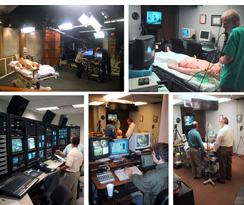
DISTRIBUTED INTERACTIVE SIMULATION AND ToL
The
Center bases its approaches to simulation on standards for Distributed
Interactive Simulation (DIS) originally developed by the military
establishments of the US and NATO, and on platforms currently used by
the US and NATO military communities (e.g., VBS2). Such a
philosophy allows interoperability of platforms used by the Center with
those favoured by a number of civilian, home defense, and military
entities in several countries. The concept of platform and environment federation constitutes
the essential foundation of the Center’s approach to simulation since
it allows true fusion of all relevant resources needed to simulate
complex and challenging healthcare scenarios relevant for regional,
national, and international level training. In that sense, the
approach to simulation practiced by the Center differs dramatically
from everything that is currently offered in health care: the Center
does not use simulation solely to train performance of specific tasks,
but in the execution of complex, system-wide functions performed often
under significant mental and physical stress. The distributed
nature of such simulations supports the rapid development of shared
Skills, Knowledge, and Attitudes that are critical for the generation
of High Performing Leader Teams. The transboundary nature of
teams involved in each simulation promotes the generation of ToL
environment in which collaborative activities of all actors are based
on mutually shared actionable understanding and directed by
the unity of purpose. In turn, the setting promotes accelerated and
operationally realistic training of Command Leader Teams™.
Even in its simplest form simulation can be challenging (link to a simple simulation game (http://www.stopdisastersgame.org/en/home.html
). The approach selected by the Center is vastly more
complex. It is unique, and, as previous work of scientists
affiliated within the center has already demonstrated, the
collaborative skills developed in the simulation environment translate
readily into skills utilized in real life settings.
|